How to Prepare Your Factory for Predictive Quality
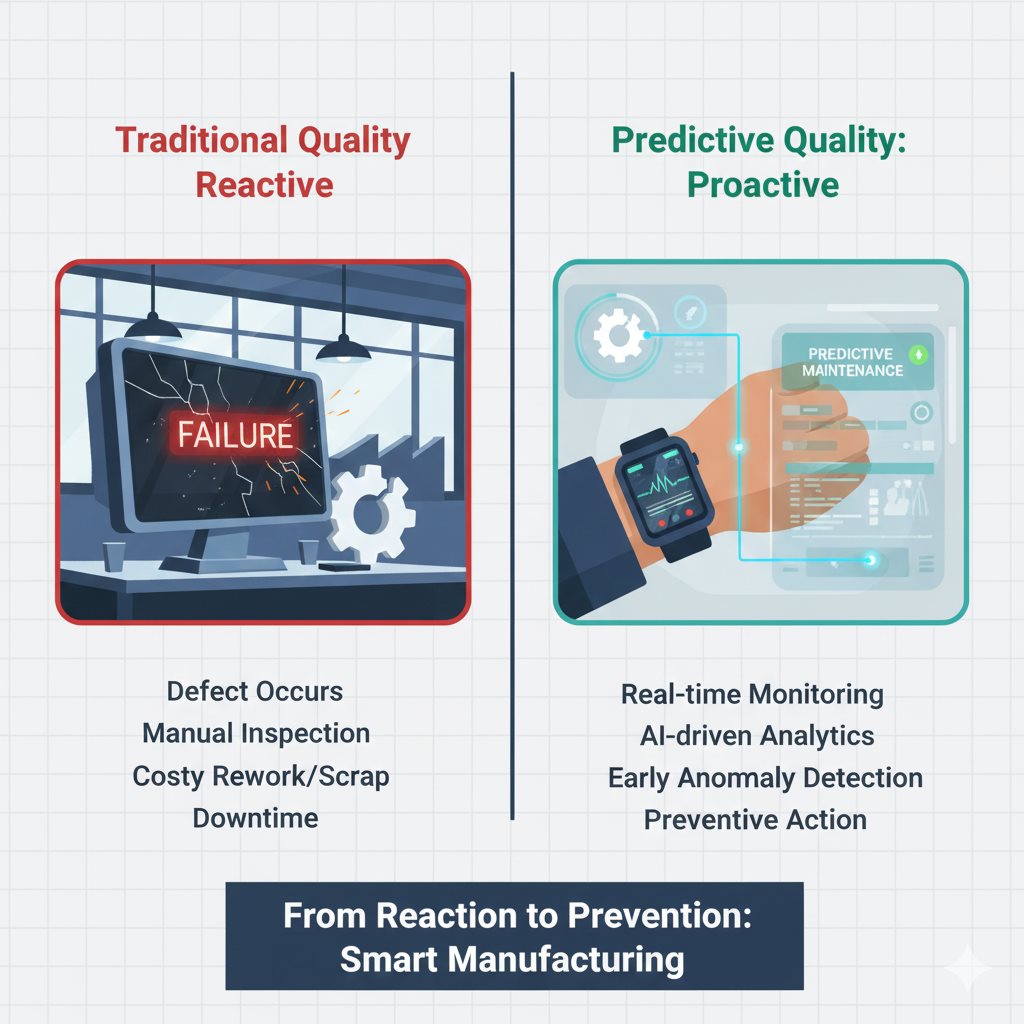
Traditional Quality Control (QC) is like driving a car by looking in the rearview mirror. You only know you hit a pothole after you feel the bump. You inspect the part at the end of the line, find a defect, and throw it in the scrap bin.
The money is already wasted. The material is gone. The machine time is lost. The energy is spent.
Predictive Quality is looking through the windshield. It warns you, "Pothole ahead in 50 meters!" so you can swerve. It allows you to adjust the process before a bad part is made.
The Health Checkup Analogy
To understand the evolution of quality, think about your own health.
- Reactive (Traditional QC): You wait until you have a heart attack, then you go to the hospital. This is expensive, painful, and risky. In a factory, this is "End-of-Line Inspection."
- Preventive (Scheduled Maintenance): You eat a salad and go for a jog because the doctor told you to. You take vitamins every day, whether you need them or not. In a factory, this is "changing the tool every 1,000 cycles," even if the tool is still good. It's safer, but wasteful.
- Predictive (AI/Smart Health): You wear a smartwatch that monitors your heart rate variability, blood pressure, and sleep patterns 24/7. It alerts you: "Your biomarkers are trending towards a cardiac event. Take medication now."
Predictive Quality does this for your machines. It doesn't wait for the "heart attack" (a bad part). It monitors the "biomarkers" (temperature, pressure, vibration, current draw) to predict when a defect is about to happen.
The "Golden Batch" vs. The "Bad Batch"
To teach a computer to predict defects, you need to feed it examples. You need two distinct datasets:
- The Input (Process Data): What happened during production? (Temperature was 205°C, Pressure was 50 bar, Injection Speed was 100 rpm).
- The Output (Quality Data): Was the part good or bad?
Many factories have the Input (in a machine log) and the Output (in a quality report), but they are never linked. They live in different databases.
The Secret Sauce: You must overlay these two datasets. You need to tell the AI: "See this spike in temperature at 10:05 AM? That caused the crack in the part we found at 10:15 AM."
Once the AI learns this pattern, it can spot the temperature spike next time and stop the machine before 10:15 AM.
How to Start (Without a PhD in Data Science)
You don't need a team of Google engineers to start. You need a practical approach.
1. Stop Throwing Away Data
Most machines overwrite their internal logs every few days or weeks. Start saving that high-resolution process data now. You can't predict the future if you don't remember the past. Store it in a Historian or a cloud database.
2. Digitalize Quality Checks
If your inspectors are writing "Pass/Fail" on paper, you are dead in the water. An AI cannot learn from a checkmark on a clipboard. Inspectors must enter exact measurements (e.g., "10.54mm") into a tablet or digital form. AI needs precise numbers to find correlations.
3. Identify Your "Critical Parameters"
You don't need to monitor everything. Ask your oldest, most experienced operator. They will say, "Yeah, when the machine starts vibrating like a washing machine, the parts come out oval." Boom. That's your first predictive model: If Vibration > X, then Defect Likely. Start there.
4. Close the Loop
The ultimate goal is not just a dashboard that says "Warning." The goal is Closed-Loop Control.
- Level 1: The system alerts the operator.
- Level 2: The system automatically adjusts the machine parameters (e.g., lowers the temperature) to compensate for the drift.
Conclusion
Predictive Quality isn't about replacing human inspectors. It's about giving them a superpower: the ability to see a defect before it even exists. It shifts your quality team from "policemen" who catch bad guys to "doctors" who keep the patient healthy.