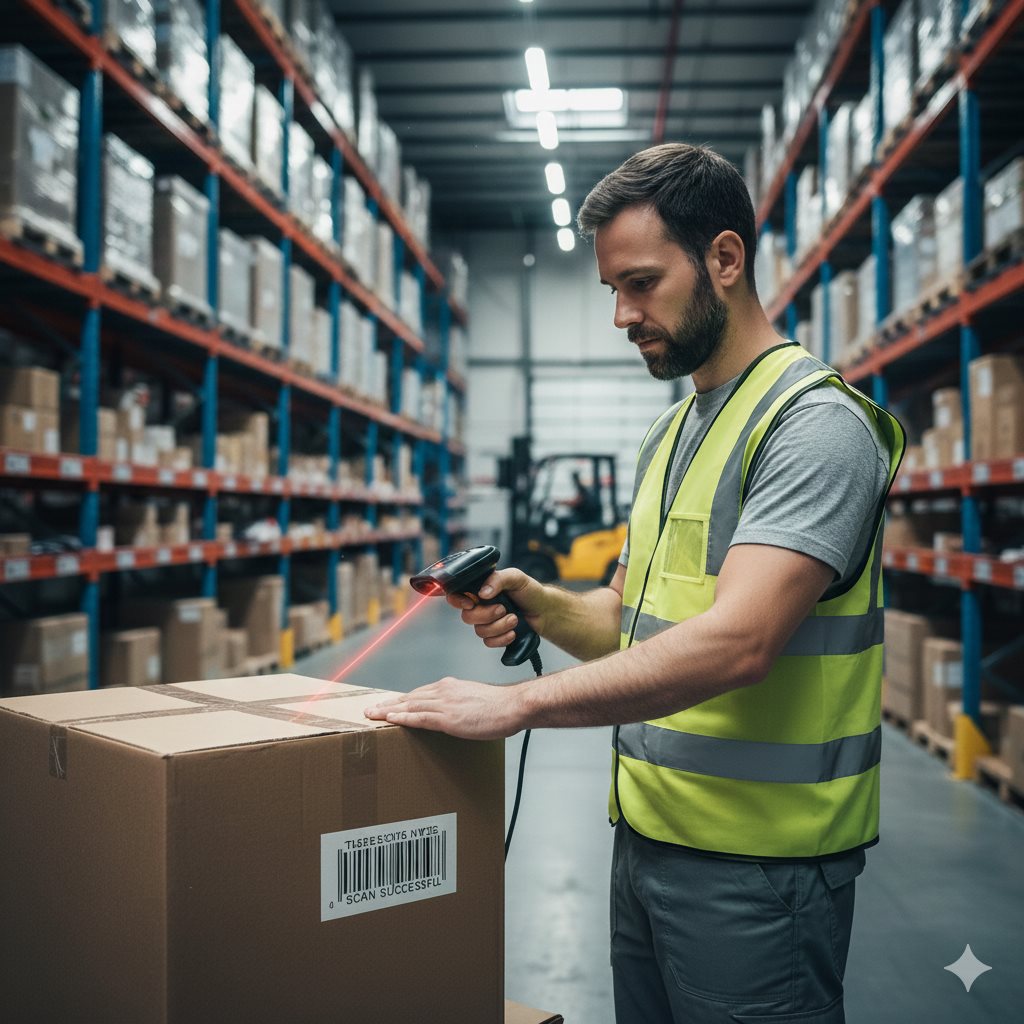
Barcode Traceability: The Foundation of Smart Manufacturing
Before AI, before IoT, and before "Digital Twins," there was the barcode.
While it might seem like "old" technology, the humble barcode remains the absolute bedrock of digital manufacturing. Without a robust barcode traceability system, advanced analytics are impossible because you lack the fundamental data of what is moving where.
What is Barcode Traceability?
Barcode traceability is the practice of tracking materials and products through the manufacturing process by scanning unique identifiers.
It answers the "4 Ws" of production:
- What: Which part number and batch?
- Where: Which location or machine?
- When: What time did it arrive/leave?
- Who: Which operator handled it?
The Two Types of Traceability
1. Lot/Batch Traceability
Used for bulk materials (e.g., plastic pellets, flour, screws). You track a "Lot Number."
- Example: "We used 50kg from Lot #ABC-123 to make these 1,000 widgets."
- Goal: If Lot #ABC-123 is found to be defective, you can recall all 1,000 widgets.
2. Serialized Traceability
Used for high-value or safety-critical items (e.g., circuit boards, medical devices, engine blocks). You track a unique "Serial Number" for each individual unit.
- Example: "Serial #XYZ-789 went through the oven at 10:05 AM at 200°C."
- Goal: Precise history of a single unit's lifecycle.
Is Barcode Traceability Right for Every Product?
While powerful, item-level barcode traceability is not a one-size-fits-all solution. It is most valuable for discrete manufacturing—where products are distinct, countable units like cars, electronics, or medical devices.
The Challenge of Size and Form Factor
Some products are simply too small or irregularly shaped for a standard adhesive label. A surgical screw or a microchip cannot hold a traditional 1D barcode.
- 2D Data Matrix: For small items, manufacturers often use 2D Data Matrix codes. These can store more data in a tiny square footprint (often just a few millimeters wide).
- Direct Part Marking (DPM): Instead of a sticker, the code is permanently laser-etched or dot-peened directly into the material. This is common in aerospace and automotive parts that must endure high heat or harsh chemicals.
Continuous vs. Discrete Industries
For process industries (like oil & gas, food & beverage, or chemicals), you cannot put a barcode on a liter of milk or a pile of flour while it is in the tank.
- Process Strategy: In these cases, traceability is handled by batch/lot tracking based on time and vessel. You track the flow from Tank A to Mixer B.
- Packaging: The barcode usually appears only when the product is packaged into a discrete unit (a bottle, bag, or box).
Cost vs. Value
There is also an economic factor. Serializing every single €0.05 plastic washer is likely overkill. In these cases, tracking at the box or bin level is sufficient. However, for a €5,000 aircraft component, individual serialization is not just justified—it's often mandatory.
How to Implement a System
Implementing barcode traceability requires three main components:
1. The Labeling Strategy
You need to label everything.
- Raw Materials: If suppliers don't provide barcodes, print your own "Internal Lot Labels" upon receiving.
- WIP (Work in Process): Use "Travelers" or route sheets with barcodes that follow the physical parts.
- Finished Goods: Print customer-compliant labels (e.g., GS1 standard) at the end of the line.
2. The Hardware
- Scanners: Handheld scanners for mobile operators, or fixed-mount scanners on conveyors for automated reading.
- Printers: Industrial thermal transfer printers are standard for durability.
- Mobile Computers: Tablets or rugged PDAs that allow operators to scan and view data simultaneously.
3. The Software (MES/WMS)
Scanning a barcode is useless if the data goes nowhere. The scanner must be connected to a system (like an MES) that:
- Validates the scan ("Error: Wrong material scanned!").
- Records the transaction timestamp.
- Updates inventory levels instantly.
The Benefits Beyond "Tracking"
Error Proofing (Poka-Yoke)
This is the biggest immediate ROI. If an operator tries to load "Resin A" into a machine that requires "Resin B," the scanner will beep red and lock the process. This prevents costly mixing errors.
Real-Time Inventory Accuracy
Manual cycle counts are slow and inaccurate. With barcode scanning, inventory is deducted the second it is consumed. Your ERP inventory levels actually match the physical shelf.
Faster Shipping
Scanning pick-lists ensures that the right product goes into the right box. No more shipping errors and angry customers.
Conclusion
Don't overlook the basics. While AI and predictive analytics are exciting, they rely on clean, granular data. A solid barcode traceability system provides that data. It is the first and most important step in digitizing your factory floor.