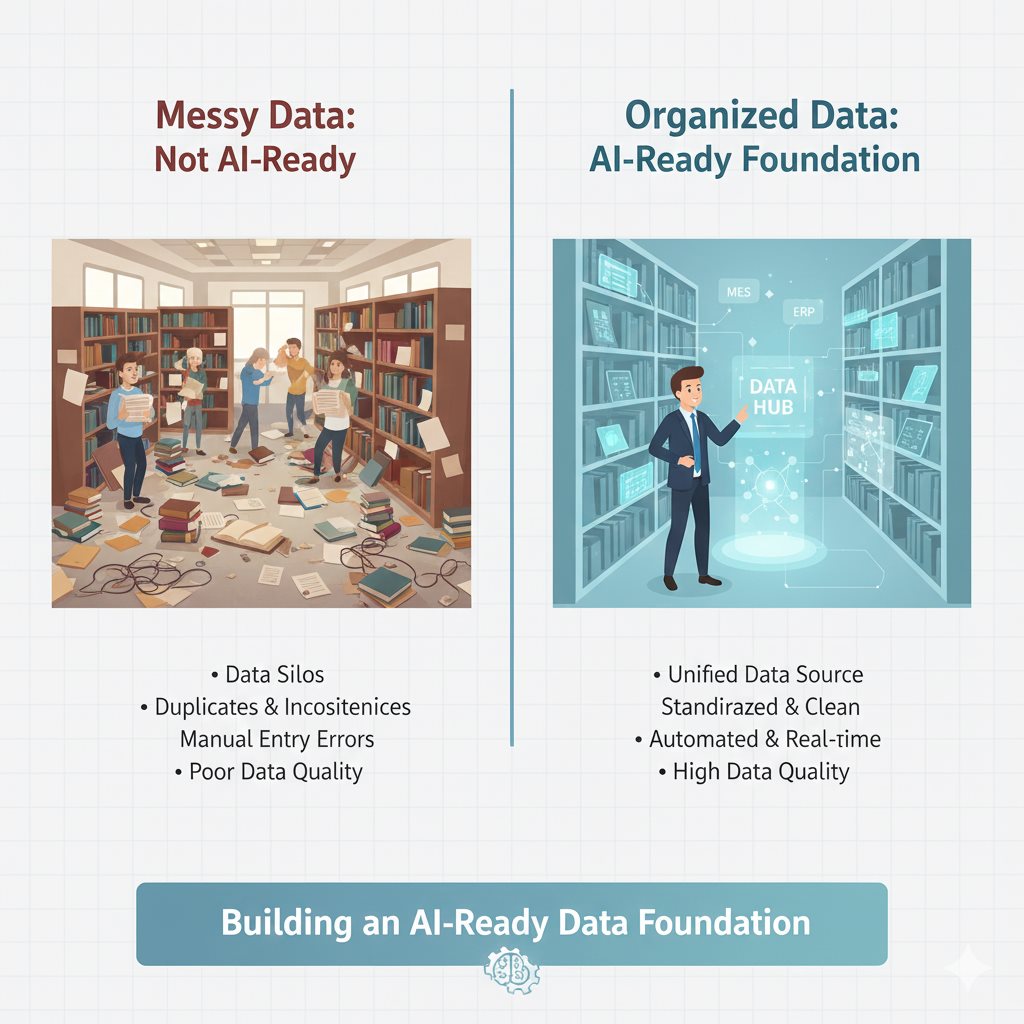
Building an AI-Ready Data Foundation
Everyone wants to "do AI." Executives read about ChatGPT, predictive maintenance, or computer vision and demand to know when their factory will be "AI-powered."
But trying to add AI to a typical factory is like trying to build a skyscraper on a swamp. If the foundation—your data—is messy, unstable, and unstructured, the structure will collapse. The algorithms are only as good as the fuel you feed them.
The Library Analogy: Why "Big Data" Isn't Enough
Imagine you want to train a brilliant student (the AI) to be an expert on your factory's history and operations. You send them to a library (your database) to learn.
Scenario A: The Messy Library
- Books are thrown in a giant pile on the floor.
- Half the pages are torn out or coffee-stained.
- Some books are written in a secret code that only "Bob from Maintenance" knows.
- The "History" section is mixed with the "Fiction" section.
- There are no dates on the newspapers.
The student will learn nothing. Or worse, they will learn the wrong things. This is what most factory data looks like today: unconnected spreadsheets, paper logs, proprietary machine protocols, and "data lakes" that are actually data swamps.
Scenario B: The Organized Library
- Books are shelved by category (Contextualized).
- Every book has a standard index and table of contents (Structured).
- Missing pages are noted or restored (Data Quality).
- The language is consistent across all volumes (Standardized).
This is an AI-Ready Data Foundation.
The 3 Steps to Clean Up the Library
To get from Scenario A to Scenario B, you need to focus on three pillars of data readiness.
1. Contextualization (The "Who, What, Where")
Raw sensor data is often meaningless. A temperature sensor reading of "450°C" tells you nothing on its own.
- Is that high? Maybe for the freezer, but not for the oven.
- What product was inside? Maybe Product A needs 450°C, but Product B melts at 400°C.
- Which order was running? Was this a customer order or a test run?
You must link the process data (time-series sensor readings) with the business data (work orders, product specs, shift schedules). An MES (Manufacturing Execution System) does this automatically, creating a "context frame" around every data point.
2. Standardization (Speaking One Language)
Factories are a Tower of Babel.
- Machine A (German) reports speed in "meters per minute."
- Machine B (American) reports speed in "feet per second."
- Machine C (Legacy) reports speed as a raw voltage (0-10V).
An AI cannot find patterns if the units don't match. It will think Machine C is running at "5" (Volts) while Machine A is running at "300" (m/min), assuming Machine A is 60x faster.
You need a Normalization Layer—middleware that converts everything into a common standard (e.g., SI units) before it hits the database.
3. Completeness and Continuity (Filling the Gaps)
AI models, especially for time-series forecasting, hate gaps. If your network drops out for 10 minutes every hour, the AI sees "black holes" in the timeline. It might interpret a network outage as a machine downtime, leading to false conclusions.
You need robust Edge Buffering. This means the machine or gateway stores data locally when the network is down and "backfills" it to the server once the connection is restored.
The "Cloud vs. Edge" Debate
Where should this library live?
- The Cloud: Great for long-term storage and training heavy models (e.g., analyzing 5 years of data to find seasonal trends).
- The Edge: Essential for real-time execution. If you want an AI to stop a machine before it breaks, the AI needs to live on the machine (Edge), not in a data center 500 miles away.
An AI-ready foundation usually involves a hybrid approach: Train in the Cloud, Deploy at the Edge.
Don't Buy the Roof Before the Foundation
Many companies make the mistake of buying expensive AI tools or hiring data scientists first, only to realize they have no clean data to feed them. The data scientists spend 90% of their time "janitoring" the data (cleaning, sorting, fixing) and only 10% actually building models.
The Correct Order of Operations:
- Digitize: Get rid of paper.
- Centralize: Connect machines to a single MES/Historian.
- Contextualize: Ensure data is tagged with product/order info.
- Analyze: Now you are ready for AI.
Conclusion
AI is not magic; it is math. And math requires good numbers. If you want the "magic" results of predictive maintenance, yield optimization, and autonomous scheduling, you have to do the hard work of organizing your library first.